Does Antifungal Nail Polish Actually Work? A Podiatrist's 7-Fact Honest Look at the Format

After looking at every OTC and prescription nail lacquer marketed for fungal toenail infection — from drugstore polishes to Rx Penlac — here's what actually works, what's just cosmetic, and why most podiatrists recommend a different format entirely for the 9-month grow-out.

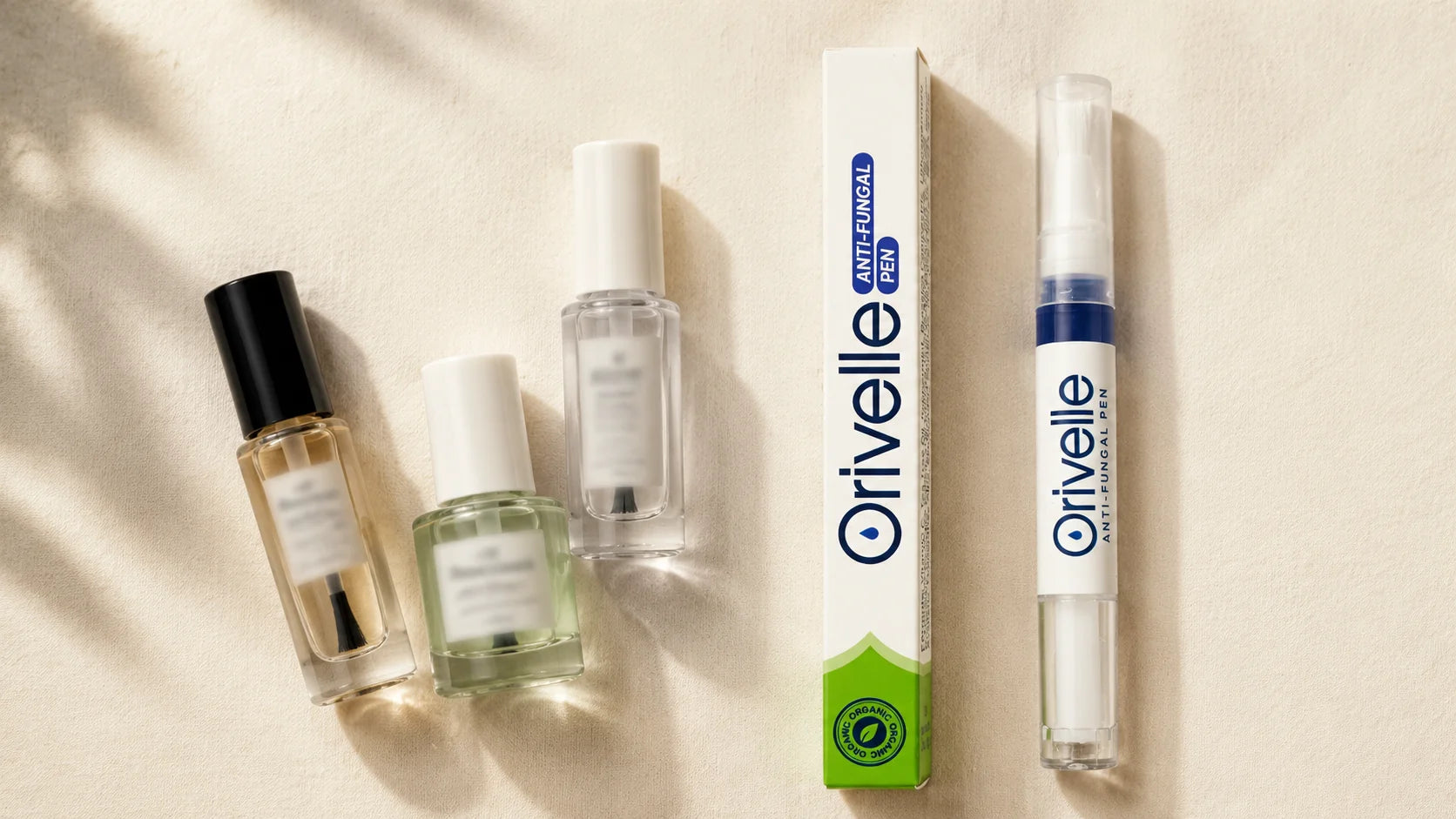
Editorial flat-lay hero showing nail polish bottles with brush applicators on the left, and the Orivelle anti-fungal pen with its green-and-white box on the right, on a warm cream linen surface, soft natural daylight.
Polish-format antifungals (left) · Orivelle pen-format antifungal (right)

Why this matters

If you've Googled 'antifungal nail polish' or 'antifungal nail varnish' in the last week, you've probably noticed something confusing: the products that come up include one prescription-grade nail lacquer with FDA approval — and a long tail of OTC drugstore products with names that suggest antifungal action but labels that carefully avoid the word.

That's not an accident. 'Antifungal nail polish' exists as a search term because it's what patients want to find. It exists less reliably as a product category, because the FDA's distinction between cosmetic nail polish and antifungal drug product is strict and expensive to cross. Below, the honest 7-fact breakdown — what's prescription, what's cosmetic, what works at the 9-month mark, and why the format itself has a ceiling.

'Antifungal nail polish' exists in two completely different categories.

Before anything else, this distinction matters more than any individual product on the list. There are two kinds of products being sold under 'antifungal nail polish' search terms:

(a) FDA-approved prescription antifungal nail lacquers. This is a small category — there's effectively one product, Penlac (ciclopirox 8% nail lacquer), generic available, requires a prescription. It's a genuinely tested antifungal with clinical data behind it.

(b) OTC 'antifungal' nail polishes / varnishes. This is a much larger category — drugstore and DTC products marketed with antifungal-adjacent language ('for nail fungus,' 'fights nail fungus,' 'antifungal protection') but classified as cosmetic nail products by the FDA. Their labels carefully avoid claiming to treat fungal infection because cosmetic classification prohibits drug-level claims.

This split matters because the two categories perform completely differently. The Rx category has clinical data. The OTC cosmetic category has marketing language. Patients don't always know the difference — partly because the marketing doesn't make it obvious.

The only FDA-approved antifungal nail lacquer is Rx Penlac (ciclopirox 8%).

Let's give the prescription option its full credit, because it earns it.

Penlac (ciclopirox 8% nail lacquer) — generic available — is the only FDA-approved topical nail lacquer specifically indicated for mild-to-moderate onychomycosis caused by Trichophyton rubrum. It was approved in 1999 and has been the standard prescription topical-lacquer option for over 25 years.

What the clinical data actually says:

· Complete cure rate at 48 weeks: roughly 5.5–8.5% in the FDA pivotal trials
· Mycological cure rate (fungus killed but nail not yet visibly clean): 29–36%
· Treatment effectiveness rate: 8.5–12%
· Application: daily, with weekly removal of the polish layer using alcohol — a real adherence challenge across the 48-week regimen

So Penlac works at the chemistry level — it's a real antifungal — but the complete-cure numbers are sobering. Roughly 1 in 12 patients achieve full clinical cure at the end of nearly a year of nightly application. That's not a knock on the active compound — it's the physical limitation of the polish/lacquer format itself, which we'll get to in #4.

If you're considering Penlac, see your podiatrist or dermatologist for a prescription. It's a legitimate option, especially if you have insurance coverage. But understand the realistic outcome data.

Most OTC 'antifungal nail polishes' are cosmetic, not antifungal.

This is where the category gets confusing for patients and where most affiliate-style listicles avoid being specific.

OTC nail-polish products marketed with antifungal-adjacent language — Dr.'s Remedy, Sally Hansen Fungal Damage Solution, and a long tail of Amazon brands using similar terminology — are almost universally classified by the FDA as cosmetic nail products, not antifungal drug products.

Read their labels carefully and you'll find language like:

· 'For healthier-looking nails'
· 'Designed for nails affected by fungal damage'
· 'Helps protect against further damage'
· 'With added antifungal-friendly ingredients'

What you won't find on a properly-labeled OTC cosmetic nail polish is 'treats fungal infection,' 'kills fungus,' or 'prevents reinfection' — because making those claims would require submitting the product as a drug, going through FDA approval, and meeting the same clinical-data bar Penlac met.

This isn't fraud. The brands aren't lying. They're using exactly the language their FDA classification permits. The confusion comes from the search term — patients are searching 'antifungal nail polish' because that's the question they have, and the products that appear in search results often have antifungal-sounding marketing on top of cosmetic FDA classification.

If you read the label and the active ingredients are listed as cosmetic nail-care compounds (urea, lactic acid, vitamin E, garlic extract, tea tree oil at low concentrations) rather than as a drug-strength antifungal active, you're holding a cosmetic nail product. It might make your nail look better. It probably won't kill the fungus underneath.

The polish format itself has a ceiling — even Penlac hits it.

Here's the most-leveraged fact on this page.

Even prescription Penlac, with documented clinical activity against T. rubrum, struggles to achieve high complete-cure rates. The bottleneck isn't the active compound. It's the format.

A polish or lacquer applied to the surface of a fungal toenail does three things:

(1) It coats the outside of the nail plate
(2) It dries into a film over the surface
(3) It seals the nail surface against re-application unless removed first (which is why Penlac requires weekly alcohol removal)

What it doesn't do well is penetrate the keratin matrix of a thick fungal toenail to reach the colony of dermatophyte fungi living underneath. The colony is what's actively destroying the nail from below. A polish layer on top of the nail can't reach it directly — it relies on slow diffusion of the active through the nail plate, and the keratin matrix of a thick infected nail blocks 70–90% of small-molecule diffusion.

That's why Penlac's complete-cure rate is in the single digits despite being a real antifungal. The chemistry works. The delivery format limits how much active actually reaches the fungus.

This isn't a critique of Penlac specifically — it's a category-level limit on lacquer formats. Cosmetic OTC 'antifungal polishes' face the same penetration problem plus they don't have a drug-strength active in the first place.

Pen format with nano-emulsification is what addresses the penetration ceiling.

If polish-format products are limited by the keratin matrix blocking the active from reaching the colony underneath, the engineering question is: what delivery format gets the active through the nail plate?

Two things change the math:

(a) Nano-emulsification — emulsifying the antifungal active at a particle size designed to penetrate the keratin matrix rather than sit on top of it. The active doesn't depend on slow diffusion through a sealed polish layer; it absorbs into the nail plate.

(b) Precision pen applicator — coats the nail, the cuticle, and the surrounding skin in a controlled antifungal layer that absorbs rather than dries into a sealed coating. No weekly alcohol removal required.

The combination is what most modern OTC antifungal pens (Lunavia, Kerassentials, Orivelle) use — varying in active ingredient and supporting botanical complex, but all in pen format because pen format with the right formulation chemistry beats lacquer format on penetration, even before factoring in cost or convenience.

For users who'd been considering Penlac or an OTC 'antifungal polish,' the OTC pen route is what most podiatrists I know would point to first — not because polish doesn't work in principle, but because the format ceiling on lacquers is well-documented and the alternative format isn't more expensive.

Older couple walking barefoot together on a wooden deck overlooking a meadow, candid editorial lifestyle, soft daylight.
200,000+ customers running a pen-format antifungal across the 9-month grow-out window.

The product: Orivelle's nano-formulated tea tree oil pen.

Putting the previous five points together:

Orivelle is a direct-to-consumer pen-format antifungal built on a 17-botanical synergistic complex led by nano-formulated tea tree oil — a compound with documented antifungal activity against the same dermatophyte strains causing onychomycosis (Buck et al. 1994, J Family Practice; Frontiers in Microbiology, 2024). The lead antifungal is emulsified at a particle size designed to penetrate the nail plate rather than coat its surface, with 16 supporting botanicals (vitamin C, jojoba, evening primrose, rosehip, plus 12 more) that maintain antifungal pressure on the nail without disrupting the surrounding skin's pH 4.5–5.5 acid mantle.

What this gets right that polish/lacquer formats don't:

(1) Nano-formulation for actual nail-plate penetration

(2) Pen-format precision applicator that delivers a controlled antifungal layer instead of sealing the surface

(3) Multi-botanical synergistic complex that supports the surrounding skin barrier across the 9–12 month grow-out window — without the once-weekly alcohol removal a lacquer like Penlac requires

Pricing: $19.99 single (50% off $39.99), or $9.99 per pen on the 6-pack ($59.94 total). 30-day money-back guarantee direct from the manufacturer. 200,000+ verified customers, 4.9★ across 5,731+ reviews, 84% reported success rate, first visible improvement within 5–7 days for most users.

For most patients I see who've been researching antifungal nail polishes and want the OTC route that solves the format ceiling, this is what I'd put first.

The questions you'll want answered before you decide.

Should I just ask my doctor for Penlac?

It's a legitimate option for mild-to-moderate cases. Insurance coverage varies — without coverage, generic ciclopirox 8% nail lacquer can run $50–$150/month at retail pharmacy. Realistic complete-cure expectation is 5.5–8.5% at 48 weeks with strict daily application + weekly alcohol removal. If you have insurance and your podiatrist recommends it, it's reasonable. For most users who can't justify the prescription pathway or want the format that solves the penetration ceiling, the OTC pen route is the alternative.

What about cosmetic OTC polishes like Dr.'s Remedy or Sally Hansen?

If your goal is making your nail look cosmetically nicer while it grows out, those products do that job. They don't claim to kill the fungus and they're not designed for that. If your goal is killing the fungal infection underneath, those products aren't the tool — by their own FDA classification.

Can I use a cosmetic antifungal polish AND an antifungal pen?

Many users do — pen for the antifungal job at night, cosmetic polish during the day for appearance, alternating with consistent removal. There's no clinical contraindication. The pen does the active work; the cosmetic polish handles the appearance.

Why is Orivelle's guarantee only 30 days?

It's shorter than some competitors' 90-day windows. If a longer guarantee window matters to your purchase decision, that's a fair trade-off to weigh. Most users see first improvement well inside the 30-day window per the manufacturer's reporting.

The bottom line

What to do next

'Antifungal nail polish' splits into three categories: (1) Rx Penlac — real antifungal, real clinical data, real prescription pathway, ~5.5–8.5% complete cure at 48 weeks; (2) OTC 'antifungal polishes' — cosmetic products with antifungal-adjacent marketing, useful for appearance, not for killing fungus; (3) OTC pen-format antifungals — the format that addresses the penetration ceiling.

  1. If you have insurance + a podiatrist

    Rx Penlac is a legitimate option. Real antifungal, real clinical data. Realistic 5.5–8.5% complete cure at 48 weeks. Reasonable choice with insurance coverage.

  2. If you saw an OTC 'antifungal polish' at the drugstore

    Read the label. If it says 'for healthier-looking nails' instead of 'treats fungal infection,' it's a cosmetic — useful for appearance, not for killing fungus.

  3. If you want the OTC route that solves the format ceiling

    Pen-format antifungal with nano-emulsification beats lacquer on penetration. Orivelle's 17-botanical pen at $9.99/pen on the 6-pack is what we'd put first.

Orivelle's 17-botanical pen at $9.99/pen on the 6-pack is what we'd put first for most patients researching this category. Pen format solves the penetration ceiling that limits all polish/lacquer products. Nano-formulated tea tree oil delivers documented antifungal activity to the colony underneath the nail plate, not just the surface.

Current pricing on Orivelle's official site:

  • 1 pen

    $19.99

    $39.9950% off

  • Best Value

    6 pens (3 + 3 free)

    $9.99 each · $59.94 total

    $199.8070% off

For most patients I see who've been searching antifungal nail polishes and want the OTC route that solves the format ceiling, I'd suggest the 6-pack. Per-pen price drops to $9.99 — and you have enough pens to use consistently for the 9 to 12 months a thick fungal toenail needs to fully grow out from the matrix.

Clean product shot of the Orivelle anti-fungal pen and box on a soft beige marble surface, daylight, no marketing graphics.

30-day money-back guarantee · Free shipping · 200,000+ verified customers · 4.9-star rating across 5,731+ reviews · 84% reported success rate