Does Coconut Oil Work on Toenail Fungus? A Podiatrist's 5 Honest Facts About the Most-Searched DIY Remedy

Caprylic acid and lauric acid — the two main antifungal compounds in coconut oil — do have documented activity against dermatophyte fungi in lab studies. So why doesn't a $5 jar of coconut oil from the grocery store actually clear most fungal toenails? The answer comes down to the same problem that limits every topical antifungal — and the format that solves it.

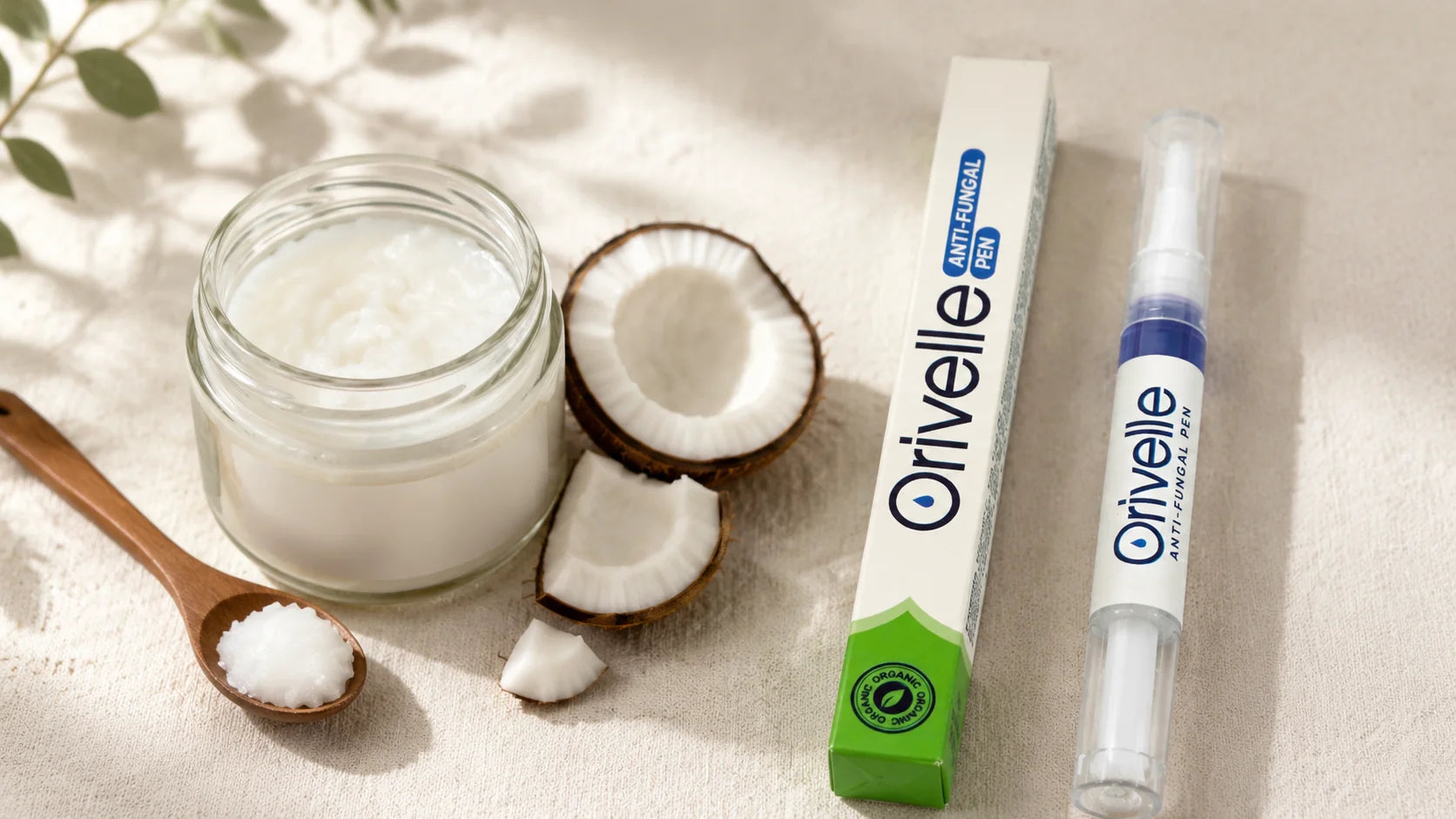
Editorial flat-lay hero showing a small open jar of coconut oil with a wooden spoon, fresh coconut halves, and the Orivelle anti-fungal pen on a warm cream linen surface, soft natural daylight.
Coconut oil DIY remedy (left) · Orivelle nano-formulated pen (right)

Why this matters

Coconut oil is one of the most-searched DIY remedies for toenail fungus on the internet. It's also one of the most-recommended on Reddit, Pinterest, and natural-health blogs — typically with some version of 'just rub coconut oil on your nail twice a day and watch the fungus disappear in 90 days.'

The problem with that advice isn't that it's wrong about coconut oil. It's that it's incomplete. Coconut oil does have documented antifungal activity at the lab-study level. What most articles skip is the part about why most users who try it don't get the result the in-vitro studies suggested they would — and the same physical limitation applies to virtually every DIY topical remedy in this category. Below, the honest 5-fact breakdown.

Coconut oil's antifungal compounds are real — but the evidence stops at 'in vitro.'

Start with what the science actually says, because it gets misrepresented in both directions on the internet.

Coconut oil contains two primary medium-chain fatty acids with documented antifungal activity in laboratory settings:

(a) Caprylic acid (C8) — the main antifungal compound in coconut oil, with documented activity against Candida species and several dermatophyte strains in lab cultures. Capsule and supplement form is sometimes used by holistic practitioners for systemic Candida.

(b) Lauric acid (C12) — the most abundant fatty acid in coconut oil (about 50% of fatty-acid content). Has documented antimicrobial activity against various pathogens including some fungal species.

So when a Reddit thread says 'coconut oil has antifungal properties,' that's literally true. The lab evidence supports it.

What the lab evidence does NOT show is that 100% virgin coconut oil applied topically to a thick fungal toenail clears the infection at clinically meaningful rates. There are no large randomized controlled trials of coconut oil for onychomycosis. What exists is in-vitro evidence (compound activity in a petri dish), some case reports, and a lot of anecdotal use.

Compare this to tea tree oil, which has an actual 1994 randomized clinical trial (Buck et al. in J Family Practice) showing partial-improvement rates comparable to clotrimazole. Coconut oil hasn't been studied at that level for nail fungus specifically.

So: real compounds, real lab activity, real ambiguity at the consumer-application level.

The penetration problem affects coconut oil even more than tea tree oil.

Here's where the home-remedy advice falls apart at the format level.

Pure coconut oil applied to a fungal toenail has the same fundamental problem as every other topical antifungal — the keratin matrix of a thick infected nail blocks 70–90% of small-molecule diffusion. The active fatty acids can't penetrate the nail plate to reach the colony of dermatophyte fungi underneath.

Coconut oil's situation is actually worse than tea tree oil's because:

(1) It's solid at room temperature and only liquefies above ~76°F. On the skin it warms up enough to spread, but it doesn't penetrate the nail keratin — it sits on top.

(2) It washes off easily. The active fatty acids don't bond to keratin; a single shower or sweat session removes most of what was applied.

(3) It contains no nano-emulsified or formulation-engineered version of the actives that would solve either of the above problems. A $5 jar from the grocery store is just food-grade coconut oil — same product you'd cook with.

So the user applies coconut oil → most of it sits on the nail surface → some of it washes off in the shower → the colony of fungi living deep under the nail plate is untouched. The compounds are antifungal in theory; the format makes that theoretical activity practically irrelevant.

This isn't unique to coconut oil. The exact same problem applies to garlic oil, oregano oil, olive oil, apple cider vinegar, Vicks VapoRub, Listerine, and every other DIY remedy your aunt on Facebook recommended. The active might be real. The penetration ceiling is what limits the outcome.

Anecdotal 'it worked for me' reports usually describe early-stage surface-only cases.

If you read Reddit threads, blog comment sections, or natural-health forums, you'll find genuine 'coconut oil cleared my toenail fungus' testimonials. Some are real outcomes. Most of them describe a specific subset of cases:

(a) Very early-stage involvement — a single discolored patch, no thickening, fungus still surface-level only
(b) Cases where the user was simultaneously doing other things — better foot hygiene, throwing out old shoes, not walking barefoot in gym showers, switching socks daily — and the coconut oil was correlative, not causative
(c) Cases where the original diagnosis wasn't fungal — discoloration from trauma, nail polish staining, or non-fungal nail dystrophy, all of which can self-resolve with time

For thick, established fungal toenails — the kind where the discoloration spreads toward the cuticle and the nail plate has visible thickening — coconut oil's surface-only mechanism doesn't reach what's actually causing the damage.

This isn't a critique of users who saw improvement on coconut oil. It's a clarification of what coconut oil's mechanism actually does and doesn't do. The compounds are real. The format hits a ceiling that's well-documented at the dermatophyte level.

The format that solves the penetration problem.

If DIY topicals are limited by the keratin matrix blocking the active from reaching the colony underneath, the engineering question is: what delivery format gets the active through the nail plate?

Two things change the math:

(a) Nano-emulsification — emulsifying the antifungal active at a particle size designed to penetrate the keratin matrix rather than sit on top of it. The active doesn't depend on slow diffusion through a sealed nail surface; it absorbs into the nail plate.

(b) Precision pen applicator — coats the nail, the cuticle, and the surrounding skin in a controlled antifungal layer that absorbs rather than washes off in the shower or wears down through the day.

Neither of these is something a $5 jar of coconut oil can offer. They're formulation-engineering moves that require deliberate product development. The compounds in coconut oil might work in a nano-formulated, pen-delivered format — but at that point you're not using grocery-store coconut oil; you're using a manufactured antifungal product.

Older couple walking barefoot together on a wooden deck overlooking a meadow, candid editorial lifestyle, soft daylight.
200,000+ customers running a pen-format antifungal across the 9-month grow-out window.

The product: Orivelle's nano-formulated tea tree oil pen.

For users who'd been considering DIY coconut oil and want the OTC route that solves the format ceiling:

Orivelle is a direct-to-consumer pen-format antifungal built on a 17-botanical synergistic complex led by nano-formulated tea tree oil — a compound with documented antifungal activity in actual randomized clinical trials (Buck et al. 1994, J Family Practice; Frontiers in Microbiology, 2024). The lead antifungal is emulsified at a particle size designed to penetrate the nail plate, with 16 supporting botanicals (vitamin C, jojoba, evening primrose, rosehip, plus 12 more) that maintain antifungal pressure across the 9–12 month grow-out window without disrupting the surrounding skin's pH 4.5–5.5 acid mantle.

What this gets right that coconut oil doesn't:

(1) Nano-formulation for actual nail-plate penetration

(2) Pen-format precision applicator that delivers a controlled antifungal layer instead of sitting on the surface or washing off

(3) Tea tree oil as the lead active — which has the randomized clinical trial evidence coconut oil lacks for nail fungus specifically

(4) 16 supporting botanicals that maintain the surrounding skin barrier across months of consistent application

Pricing: $19.99 single (50% off $39.99), or $9.99 per pen on the 6-pack ($59.94 total) — within the same range as a quality jar of virgin coconut oil from a health-food store, on a far deeper formulation. 30-day money-back guarantee direct from the manufacturer.

For most patients I see who've tried coconut oil and watched it not deliver on a thick fungal toenail, this is the OTC route I'd suggest instead.

The bottom line

What to do next

Coconut oil contains real antifungal compounds (caprylic acid, lauric acid). The lab evidence supports their activity against Candida and several dermatophyte strains. The lab evidence does NOT translate cleanly to consumer application on a thick fungal toenail because of the same penetration ceiling that limits every DIY topical antifungal — coconut oil sits on the nail surface, doesn't reach the colony underneath, and washes off.

  1. If your case is very early-stage and surface-only

    Coconut oil + good foot hygiene might be enough. Real antifungal compounds, real lab activity. Just understand the format limit.

  2. If the nail is thickened or discoloration is spreading

    Coconut oil's surface-only mechanism doesn't reach what's actually causing the damage. The format ceiling is real.

  3. If you want the OTC route that solves the format ceiling

    Pen-format antifungal with nano-emulsification beats DIY oils on penetration. Orivelle's 17-botanical pen at $9.99/pen on the 6-pack is what we'd put first.

For very early-stage surface-only cases, coconut oil might be enough alongside good foot hygiene. For thick, established fungal toenails with discoloration spreading toward the cuticle, the format limitation makes coconut oil a poor primary treatment. A nano-formulated antifungal in a precision pen — like Orivelle — is the format that addresses what coconut oil can't.

Current pricing on Orivelle's official site:

  • 1 pen

    $19.99

    $39.9950% off

  • Best Value

    6 pens (3 + 3 free)

    $9.99 each · $59.94 total

    $199.8070% off

For most patients I see who've tried coconut oil at home and watched it not deliver, I'd suggest the 6-pack. Per-pen price drops to $9.99 — within the price range of a good jar of virgin coconut oil — and you have enough pens to use consistently for the 9 to 12 months a thick fungal toenail needs to fully grow out from the matrix.

Clean product shot of the Orivelle anti-fungal pen and box on a soft beige marble surface, daylight, no marketing graphics.

30-day money-back guarantee · Free shipping · 200,000+ verified customers · 4.9-star rating across 5,731+ reviews · 84% reported success rate