Does Tea Tree Oil Actually Work on Toenail Fungus? An Honest Look at the 5 DIY Remedies Most People Try

What 30 years of patient stories and a 2024 peer-reviewed study tell us about what plant-based remedies can actually do for a fungal toenail — and the one specific reason raw tea tree oil 'turns your nail white' but doesn't clear the infection.

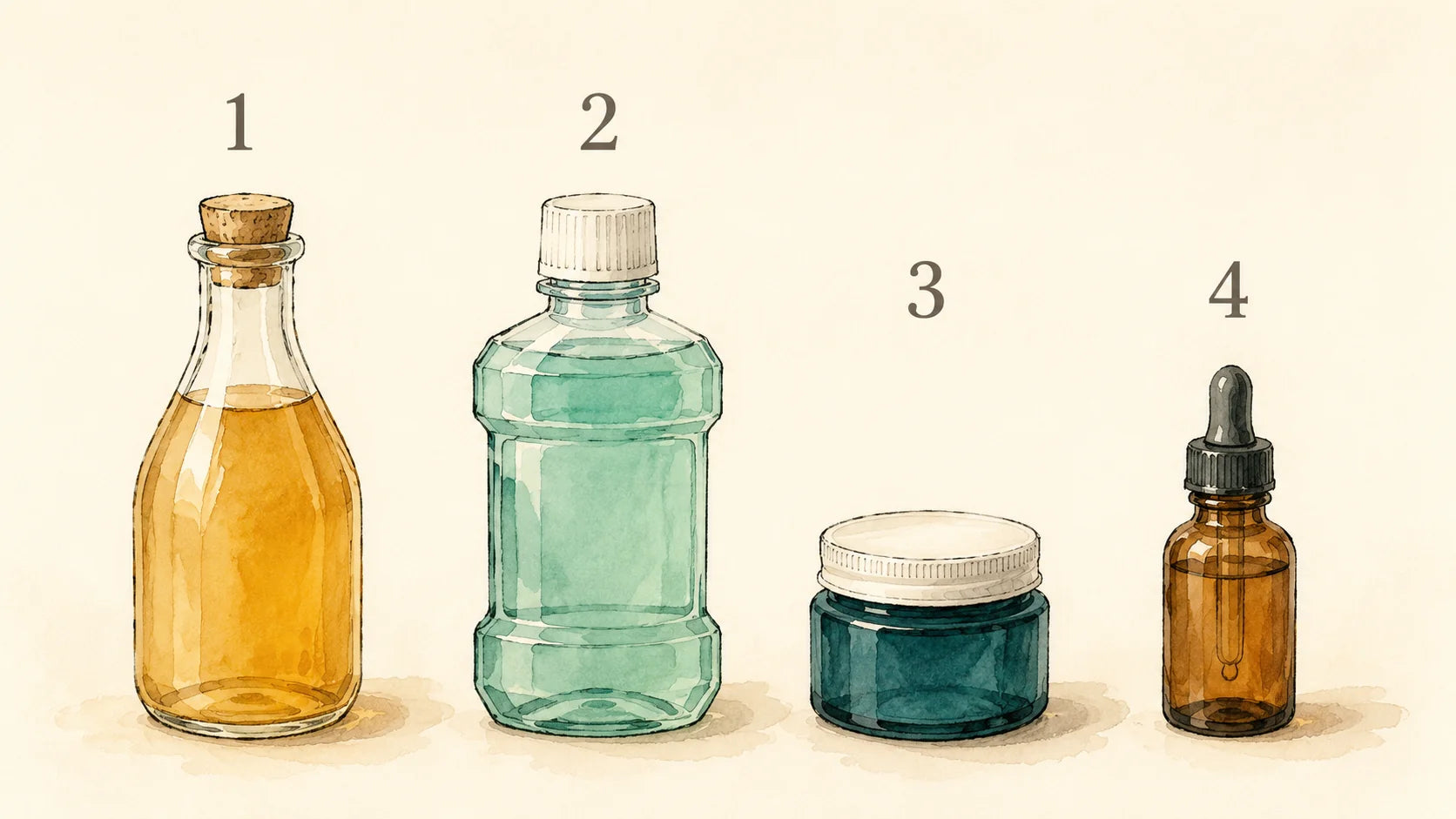
Editorial watercolor flat-lay illustration of four DIY toenail-fungus remedies in a row on a warm cream surface — vinegar bottle, mouthwash bottle, vapor rub jar, amber tea tree oil dropper — labeled 1 through 4 in soft taupe numerals.
1. Vinegar · 2. Listerine · 3. Vicks · 4. Tea tree oil · (5: revealed at the end)

The short answer

You've already opened five tabs comparing these. Vicks before-and-afters on YouTube. Some Reddit thread saying vinegar 'cured' someone's nail in two weeks. A TikTok claiming Listerine works overnight. The honest answer is messier than any single video, but here it is in five sentences.

One of these does almost nothing. Two work partially and stop. One is the right ingredient with the wrong delivery system. And one is the version of that ingredient a holistic skin specialist actually built around the biology. Tea tree oil — the most-searched DIY antifungal on the internet — sits in the 'right ingredient, wrong delivery' group. There's a peer-reviewed 2024 paper confirming its activity against the exact dermatophyte strains responsible for onychomycosis. There are also thousands of patients who've poured raw tea tree oil onto their nail with a Q-tip every night for six months and watched it plateau, then go backward.

This guide explains why, in the order I'd walk through them with you in the office: the least defensible remedies first, the one that almost works last, and the formulated version of that ingredient at the end.

Listerine Soaks: The Internet Myth That Won't Die

The least defensible of the four DIY remedies is Listerine.

The mechanism people think is at play: Listerine contains thymol, eucalyptol, and methyl salicylate (the 'essential oils'), plus alcohol. Three of those four compounds do have some documented antifungal activity in lab settings. So the YouTube logic goes: pour it in a bowl, soak your foot 20 minutes, fungus dies.

Here's what's actually happening. The active compounds in Listerine are at concentrations designed for 30 seconds of mouthwash, not penetrating compacted keratin under a thickened toenail. The alcohol kills surface fungus on the skin around the nail — which is why some people see the surrounding skin look better — but cannot reach the fungal colony living under the nail plate. There are zero peer-reviewed clinical studies of Listerine on onychomycosis. The 'before-and-after' photos circulating online are almost universally either polish staining lifting, or a different toe.

Verdict: doesn't reach the infection. Skip it.

Apple Cider Vinegar Soaks: The Right Idea, the Wrong Vehicle

The second least-effective DIY remedy — but with a real mechanism behind it — is vinegar soaks (apple cider, white, or distilled).

Fungal cells dislike acidic environments. The skin's natural acid mantle (pH 4.5–5.5) is actually one of the body's primary defenses against fungal colonization. So pouring acetic acid (vinegar's active compound, pH ~2.4) onto the nail intuitively makes sense: low pH should be hostile to fungus.

The problem is delivery. Acetic acid is volatile — it evaporates within minutes of application. To kill a fungal colony living under a hardened keratin plate, you'd need sustained acid contact for hours, multiple times per day, for months. A 20-minute foot soak doesn't even reach the colony. What it does reach is the surrounding skin and the nail surface, which is why some people report partial color improvement in the first month before plateauing entirely.

A small subset of patients also report contact dermatitis from repeated vinegar soaks — the acid that's too weak to kill the fungus is strong enough to disrupt the skin barrier above it.

Verdict: the right idea (low pH is hostile to fungus) executed with the wrong vehicle. Partial cosmetic effect on the surrounding skin; doesn't reach the colony. Worth ruling out before spending money — but don't expect it to clear a real fungal infection alone.

Vicks VapoRub: The DIY Remedy With an Actual Study (And the Catch)

This is the one most podiatrists are surprised about.

There is a real 2011 clinical study, published in the Journal of the American Board of Family Medicine, that documented a 27.8% partial cure rate at 48 weeks for daily Vicks VapoRub application on onychomycosis. The active compounds (camphor, menthol, eucalyptus oil, thymol) have documented antifungal activity. The petroleum jelly base helps the active ingredients sit on the nail longer than a soak does.

So Vicks is the only DIY remedy on this list with measured clinical data behind it. And it works — partially — for about a quarter of users.

Here's the catch nobody clipping the study mentions. The Vicks 'works for a while then stops' effect is real, and the reason is the petroleum base. Petroleum jelly is occlusive — it forms a barrier on the skin. Used continuously for months, it disrupts the skin's natural acid mantle and impairs the barrier function around the nail. Once the barrier weakens, the surrounding skin becomes more hospitable to recolonization. This is why the patient comments under almost every Vicks success story include some version of 'worked for a while, then it came back, and now it seems worse.'

Verdict: real but limited. Roughly 1 in 4 users see partial improvement; most plateau by month 2-3 and reverse by month 4-6. Worth knowing the study exists, not worth betting your year on.

Tea Tree Oil: The Right Ingredient — and Why "Tea Tree Oil Turned My Toenail White"

Here is the most-Googled DIY toenail fungus remedy on the internet, and the one with the most genuine science behind it.

Tea tree oil (Melaleuca alternifolia) does have documented antifungal activity against the exact dermatophyte strains that cause toenail fungus.

A 1994 study (Buck et al., Journal of Family Practice) compared 100% tea tree oil to 1% clotrimazole solution on 117 patients with onychomycosis. After 6 months, mycological cure rates were comparable: 18% for tea tree oil, vs. 11% for clotrimazole. Clinical improvement was reported in about 60% of both groups.

A 2024 study (Frontiers in Microbiology) reconfirmed and extended this — showing tea tree oil disrupts both fungal cell membranes and the biofilm structure that protects fungal colonies from topical treatments.

So the science is real. Tea tree oil is the right ingredient.

But here's why the 'tea tree oil turned my toenail white' comment shows up under almost every YouTube tutorial:

(1) Raw tea tree oil at 100% concentration doesn't penetrate the nail plate. Studies showing efficacy used either nano-emulsified preparations or specific carrier oils. Q-tip-from-the-Amazon-bottle delivery puts the active compound on the surface where it evaporates and oxidizes within minutes.

(2) Without synergistic compounds, raw tea tree oil loses potency fast on the dermatophytes that cause onychomycosis. Lab studies that show its efficacy use freshly-emulsified preparations — not the partially-oxidized contents of a 6-month-old bottle that's been opened nightly.

(3) Repeated daily application of 100% tea tree oil strips the skin's acid mantle and bleaches the skin around the nail. That's the 'turned my toenail white' effect — it's not the fungus dying, it's the surrounding skin being chemically traumatized. Once the acid mantle is gone, the skin around the nail becomes more hospitable to fungal recolonization. This is the Acid Trap: the natural compound that can clear the fungus, applied wrong, creates the conditions for it to come back stronger.

So the patient who painted tea tree oil on their nail with a Q-tip every night for 8 months wasn't doing nothing. They were applying the right active compound through the wrong delivery system, in the wrong concentration, without the synergistic carriers that make it actually penetrate — and in the process, they stripped the skin barrier that was their last line of defense.

Verdict: the most documented antifungal mechanism in the DIY world. Real partial activity. But raw application alone doesn't clear an established infection — and prolonged raw application makes the next infection harder to clear than the first one.

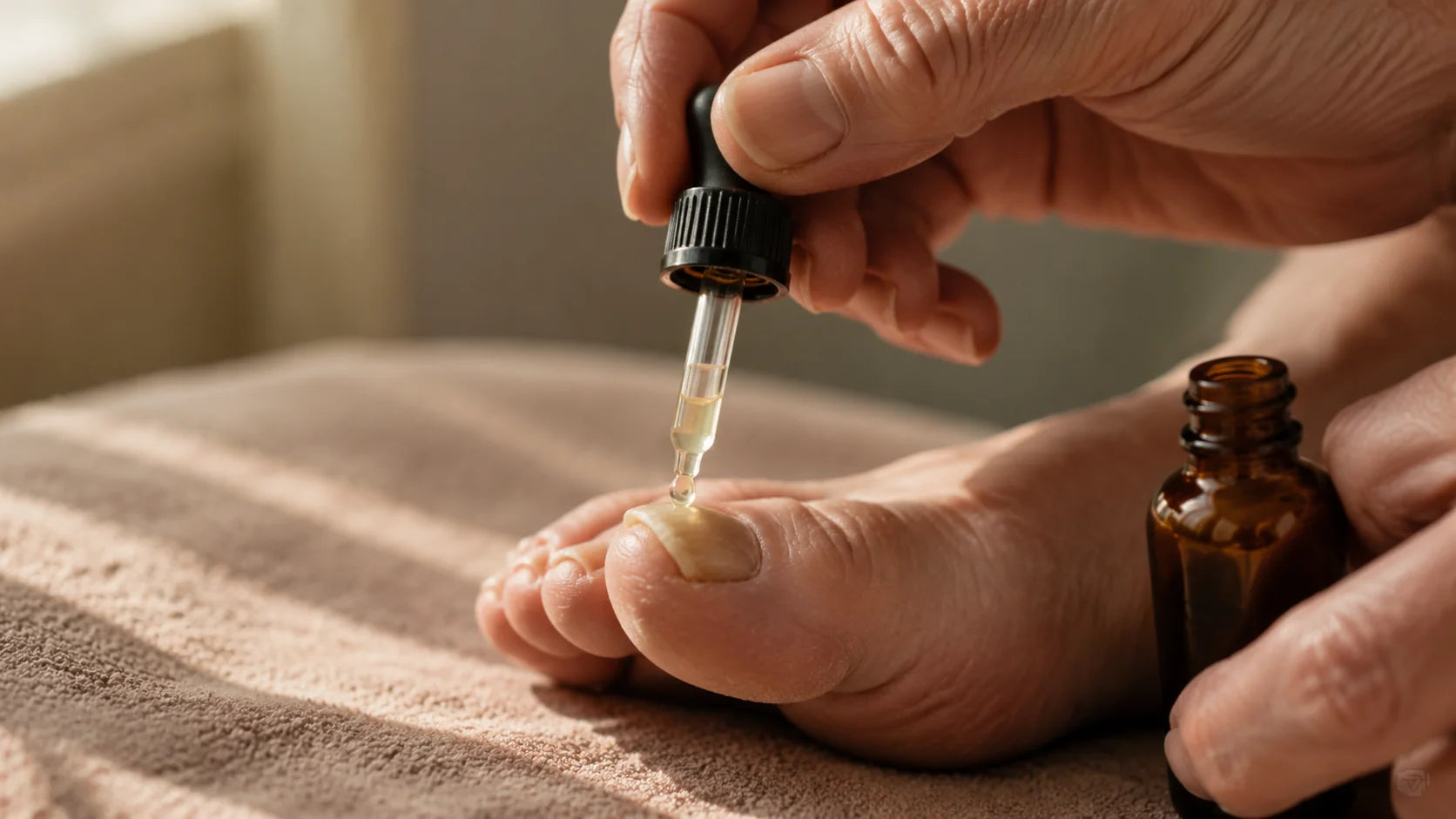
Editorial documentary photograph of an older person's hand carefully applying liquid from a small amber dropper bottle onto a thickened big toenail, soft natural daylight, candid lifestyle framing.
Raw tea tree oil applied with a dropper: the active compound is right; the delivery is wrong.

The Professionally Formulated Version: Why a Holistic Skin Specialist Built the One That Actually Penetrates

If items 1-4 are true — and the data says they are — then there's an obvious next question: what does a tea tree oil formula look like when it's actually engineered around the biology of how a fungal toenail behaves?

The honest answer comes from a holistic skin and nail specialist named Dr. Alan Meyers — the developer behind a pen-format treatment called Orivelle, currently used by more than 200,000 verified customers.

Here's what Dr. Meyers wrote about why standard treatments — including raw tea tree oil — fail:

Most over-the-counter treatments only scratch the surface — and in many cases they dry out and weaken the skin barrier, making it easier for fungus to come back.

— Dr. Alan Meyers, formulator (Orivelle product page)

That's the Acid Trap, named. It's exactly the mechanism behind why Vicks works for two months then reverses, why pure tea tree oil 'turns your nail white' without clearing anything, why repeated vinegar soaks irritate the surrounding skin without touching the colony.

Orivelle's 17-ingredient natural formula was designed around the opposite approach. Tea tree oil is the lead active — but it's nano-formulated rather than raw, paired with 16 synergistic plant compounds (vitamin C, peppermint, jojoba, evening primrose, rosehip, and 11 more) that maintain antifungal potency and support the skin's acid mantle instead of stripping it. The pen-format precision applicator delivers it directly to the nail and surrounding skin — not as a soak that evaporates, not as a Q-tip swipe, but as a coated layer absorbed exactly where the colony lives.

Same lead ingredient you've been hearing about. Different delivery system. Built by a specialist who'd watched too many of his own patients fail with raw tea tree oil and finally formulated it the way the science suggests it should have been formulated all along.

The reported numbers from Orivelle's own user study: 84% noted noticeable improvement in nail clarity and strength after consistent use. Many report first visible improvements within 5–7 days. Full restoration takes longer — toenails grow about 1mm per month, so a fully restored plate from the matrix takes 9-12 months — but the color, smell, and crumbling at the tip start changing fast.
Older man and woman walking barefoot together on a wood deck, daylight, no clinical context
Designed to support visible nail improvement — used by more than 200,000 customers.

What to do next

What to do next

If you've been Googling DIY toenail fungus remedies for a while, the takeaway is straightforward:

  1. Skip Listerine entirely

    No mechanism reaches the colony. The 'before-and-after' photos online are almost universally either polish staining lifting or a different toe.

  2. Skip vinegar soaks as a primary treatment

    Acidic skin defense is real, but a 20-minute soak can't deliver it sustainably. Some surface-skin improvement, no real penetration to the colony.

  3. Vicks VapoRub: real partial efficacy, but plateaus

    About 28% partial cure at 48 weeks per the 2011 study. Petroleum base disrupts the skin barrier; most users plateau or reverse by month 4–6.

  4. Raw tea tree oil with a Q-tip: right ingredient, wrong delivery

    Continue if you want, but don't expect it to clear a real infection alone — and watch for the 'turned white' sign that the Acid Trap has kicked in.

  5. Nano-formulated tea tree oil + 16 synergistic compounds in a precision pen

    What the science actually supports. Orivelle is the one designed around exactly this — same lead ingredient, executed correctly.

If you've been raw-applying tea tree oil for months and watching it plateau, Orivelle is the formulated version of the same active you were already trying. If you haven't tried anything yet but you wanted to start with something natural, this is the natural option that has the best shot of clearing the infection without setting up the Acid Trap.

Current pricing on Orivelle's official site:

  • 1 pen

    $19.99

    $39.9950% off

  • Best Value

    6 pens (3 + 3 free)

    $9.99 each · $59.94 total

    $199.8070% off

For most patients I see who've already tried multiple DIY remedies, I'd suggest the 6-pack — the per-pen price drops to $9.99 and you have enough to use consistently for the 9 to 12 months it takes for the natural nail to fully grow out from the matrix. (For comparison, a 48-week course of one common prescription topical runs roughly $1,700 at retail with about a 17% reported clearance rate.)

Clean product shot of the Orivelle anti-fungal pen and box on a soft beige marble surface, daylight, no marketing graphics

30-day money-back guarantee · Free shipping · 200,000+ verified customers · 4.9-star rating across 5,731+ reviews · 84% reported success rate