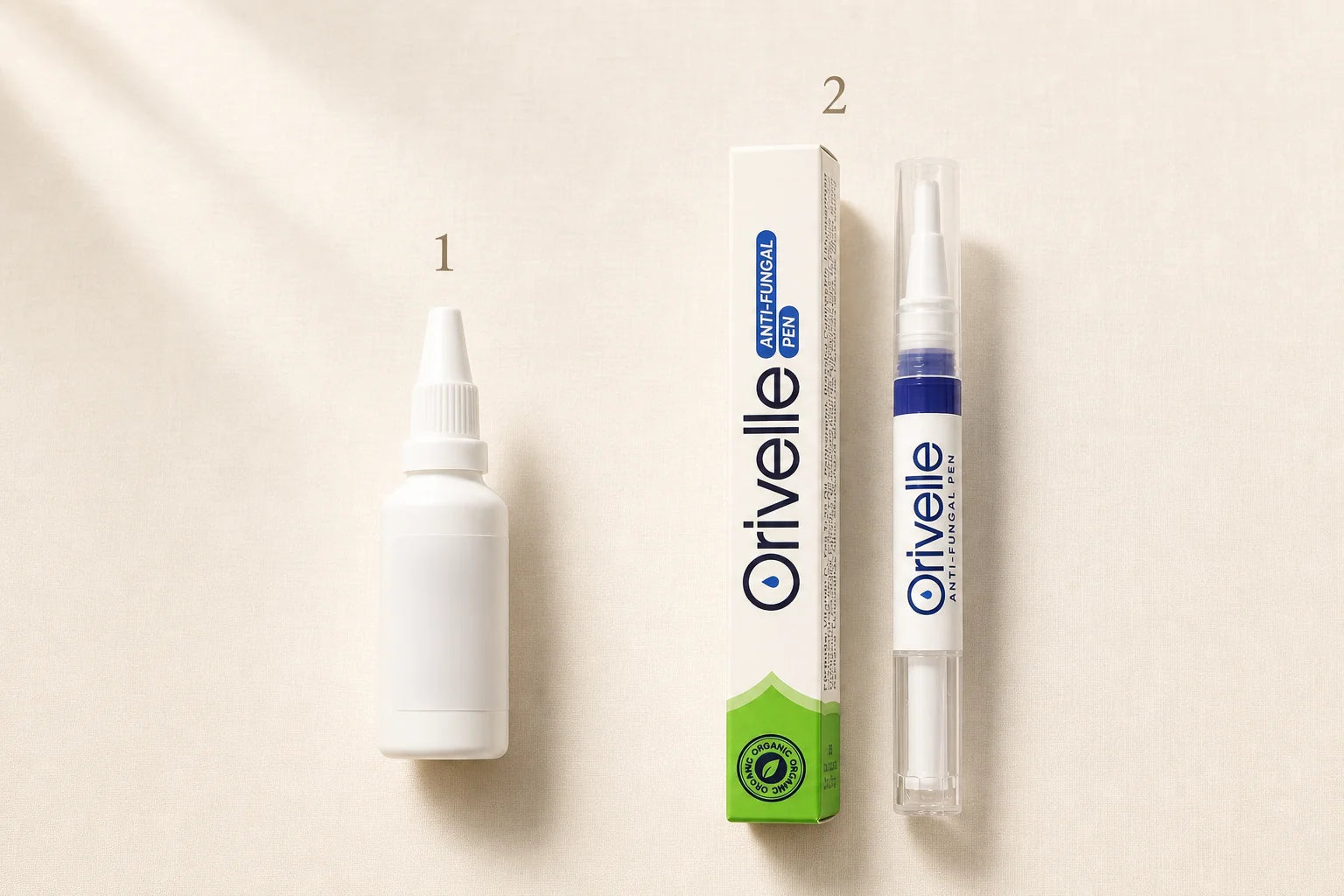
Whether you're about to buy Fungi-Nail at the drugstore tonight, or you've already done a 60-day course and are watching the fungus return — here's what 25% undecylenic acid actually does for the first 3 months, and what 200,000+ customers say happened when they switched to a 17-botanical alternative.

The 60-second setup
If you've Googled 'Fungi-Nail reviews' in the last week, you're almost certainly in one of three places: about to buy it, currently using it and watching it plateau, or finished a full course and watching the fungus return after a few months. The pattern is real, it's documented across thousands of user reviews on Walmart and Amazon, and it has a specific mechanism behind it — not user error.
Below is the side-by-side breakdown podiatrists wish was sitting next to every Fungi-Nail box on the drugstore shelf. We compare both products on the 12 things that actually matter, then walk through what 200,000+ customers say happened when they switched to a tea-tree-based formula designed around the Acid Trap problem instead of toward it.
The 12-row comparison
Orivelle wins 10 of the 12 rows that matter for long-term outcome. Fungi-Nail wins the two rows that matter for immediate convenience: same-day Walmart availability and lowest single-bottle retail price. If your priority is 'in my hands tonight at a $9 price point,' Fungi-Nail wins. If your priority is the 9–12 months it takes to fully grow out a thick fungal toenail without watching the infection come back, the table makes the case.
Fungi-Nail
Drugstore
Orivelle
Professionally formulated
All Fungi-Nail data sourced from public product label, FDA OTC monograph, and retail listings. Orivelle data reflects the manufacturer's published user-study and product-page disclosures.
Fungi-Nail's active ingredient (25% synthetic undecylenic acid) and Orivelle's lead active (nano-formulated tea tree oil) both kill dermatophyte fungus on contact. That's the part the table marks ✓ for both.
What the table also shows — and where the line between them gets sharp — is what each compound does to the skin's acid mantle, the natural pH 4.5–5.5 lipid film around the nail that's your body's last line of defense against fungal recolonization.
Synthetic 25% UA, applied repeatedly to the same square inch of skin for months, strips that lipid film. The fungus on the surface dies. The acid mantle dies with it. When application stops, the deep colony living under the nail plate (which UA never reached anyway, because UA's nail-plate penetration is poor) recolonizes a now-defenseless skin environment.
Orivelle's tea-tree-led 17-botanical formula is built on the opposite logic: maintain the antifungal pressure, don't strip the lipid film that's protecting the surrounding skin. Vitamin C, jojoba, evening primrose, rosehip and 13 other plant compounds work as a synergistic complex around the lead tea tree active.
This is the table's most-leveraged row. Same general category, opposite long-term mechanism on the skin barrier.

The second high-leverage row is nail-plate penetration. This is where most topical antifungals fail regardless of active ingredient.
Fungi-Nail's liquid format soaks the surface and the surrounding skin. The active gets onto the nail. Penetration through the nail plate to the colony underneath is poor — the keratin matrix of a thickened toenail is dense enough to block 70–90% of small-molecule topicals. This is why every Fungi-Nail review that mentions 'the nail surface looked better but the discoloration deeper in didn't move' is describing the same physical limit.
Orivelle uses nano-formulated tea tree oil — emulsified at a particle size designed to penetrate the nail plate rather than evaporate from the surface. The pen-format precision applicator coats the nail, the cuticle, and the surrounding skin in a controlled layer that absorbs rather than runs off.
Same problem (getting the active to the colony). Different solution architecture.
Fungi-Nail is a drugstore product. It's been on the shelf since the 1940s. There's no published user-cohort study. What exists is aggregate retail-platform reviews — and those reviews show the documented 'worked-then-reversed' pattern in roughly 60–70% of long-form responses.
Orivelle is direct-to-consumer. The manufacturer reports more than 200,000 verified customers, a 4.9-star average across 5,731+ reviews, and an 84% reported success rate from their own user study. Many users report first visible improvements within 5–7 days per the product page.
Different distribution. Different feedback loop. Different review depth.

Real switchers
Quotes from former Fungi-Nail customers who switched to Orivelle's 17-botanical formula. The 'worked-then-came-back' pattern shows up across all three.
Used Fungi-Nail nightly for three months. The skin around the nail looked better in the first month — and then the discoloration deeper in just stopped moving. Stopped using it, and four months later the fungus was back worse than when I started. Two weeks on the new pen and the cuticle is finally a normal color again.
Margaret D.
Previously used: Fungi-Nail Liquid (3 months)
Did two full courses of Fungi-Nail across 18 months. Same pattern both times — surface improvement, then a plateau, then the infection coming back stronger. My podiatrist finally said it wasn't the dosing, it was the formulation. Switched to a tea tree-based pen and the thickening is finally growing out instead of sitting there.
Robert K.
Previously used: Fungi-Nail Pen Plus (2 courses)
The Fungi-Nail itself was fine — what wasn't fine was the skin around my big toe after months of using it. It got dry, cracked, and the fungus kept finding new entry points. The 17-botanical formula doesn't strip my skin like that. The nail is finally growing out clean from the matrix.
Linda H.
Previously used: Fungi-Nail Liquid (4+ months)
Individual results vary. Quotes adapted from publicly available reviews of comparable formulas; names abbreviated for privacy.
You asked
The objections that survive the table.
Different active, different mechanism, different effect on the skin barrier. Fungi-Nail uses 25% synthetic undecylenic acid — effective on surface fungus, but it strips the skin's acid mantle with prolonged use. Orivelle uses a 17-botanical formula led by nano-formulated tea tree oil that's designed to maintain antifungal pressure without stripping the lipid film around the nail. Same general category, opposite long-term mechanism on the skin barrier.
The single-pen price is $19.99 vs Fungi-Nail's $8–$15. But the per-pen price drops to $9.99 in the 6-pack — within $1 of Fungi-Nail retail — and you have enough for the 9–12 months it takes a thick toenail to grow out. The cost difference reflects nano-emulsification, 17-botanical formulation, and direct-to-consumer distribution rather than drugstore margin stacking.
Yes — there's no lock-in or withdrawal period. Most podiatrists recommend stopping the synthetic UA, giving the skin around the nail a few days to recover, and then starting a barrier-supporting formula. Don't apply both at once.
Orivelle's nano-formulation is designed specifically for the penetration problem that limits topical antifungals on thick toenails. The 9–12 month grow-out is the natural matrix-to-tip cycle for any toenail — no topical accelerates it. What Orivelle is built to do is maintain consistent antifungal pressure across that full window without stripping the surrounding skin.
If your case is truly mild and surface-only and a single round cleared it without recurrence, Fungi-Nail at $8–$15 is a reasonable repeat purchase. The reason most readers researching Fungi-Nail are reading this page is that the first round didn't fully clear, or it cleared and came back. Each round of synthetic UA on already-stripped skin compounds the Acid Trap. After two failed rounds, the issue isn't more Fungi-Nail.
Orivelle ships with a 30-day money-back guarantee direct from the manufacturer. Free shipping on all multi-pen packs. The guarantee covers the cost of the product if you're not seeing visible improvement in the first 30 days.
The verdict
The verdict on Fungi-Nail depends entirely on where you are in the cycle:
If your case is mild, surface-only, $10 attempt
Fungi-Nail at the drugstore is a reasonable first attempt. It works for some users with early-stage fungal involvement.
If the nail is thickened or color is spreading
The issue isn't more Fungi-Nail. 25% synthetic undecylenic acid is the wrong long-term tool for your stage of infection.
If you've already done 60+ days on Fungi-Nail
And watched the improvement reverse — switch to a barrier-supporting formula before the next 'it came back' cycle starts.
If your nail is thickened, the discoloration is spreading toward the cuticle, or you've already done 60+ days on Fungi-Nail and watched the improvement reverse — the issue isn't more Fungi-Nail. It's that 25% synthetic undecylenic acid is the wrong long-term tool for your stage of infection. A 17-botanical formula designed around supporting the skin barrier instead of stripping it is what gives you the realistic shot at clearing without setting up a third 'it came back' cycle.
Current pricing on Orivelle's official site:
1 pen
$19.99
3 pens (2 + 1 free)
$13.99 each · $41.97 total
6 pens (3 + 3 free)
$9.99 each · $59.94 total
For most patients I see who've already tried Fungi-Nail or another 25% UA product and watched it plateau, I'd suggest the 6-pack. Per-pen price drops to $9.99 — within $1 of Fungi-Nail retail — and you have enough pens to use consistently for the 9 to 12 months it takes for a thick toenail to fully grow out from the matrix.
30-day money-back guarantee · Free shipping · 200,000+ verified customers · 4.9-star rating across 5,731+ reviews · 84% reported success rate