Whether you're researching Kerasal at the drugstore — or you've already used it for months and noticed the discoloration kept spreading underneath — here's what Kerasal's own label says about what the product can and cannot do, and what 200,000+ customers say happens when they switch to a 17-botanical formula in the actual antifungal category.

The 60-second setup
Kerasal Fungal Nail Renewal is one of the most-purchased nail products in the United States — sold at every CVS, Walgreens, Walmart, and Target in the country, marketed as '#1 Doctor Recommended,' and on store shelves for over 20 years. It is also, per its own label and FDA classification, a cosmetic — not an antifungal.
This isn't editorial framing. It's how the product is registered. Kerasal's own product description on kerasal.com uses careful language: 'visibly improves the appearance of nails damaged by nail fungus.' It does not say it treats fungal infection. It does not say it kills fungus. It does not say it prevents reinfection. The active ingredients are urea, propylene glycol, glycerin, and lactic acid — keratin softeners and moisturizers, not antifungal compounds. The product softens the thickened, discolored keratin of a damaged nail and improves how that nail looks. That's the entire claim.
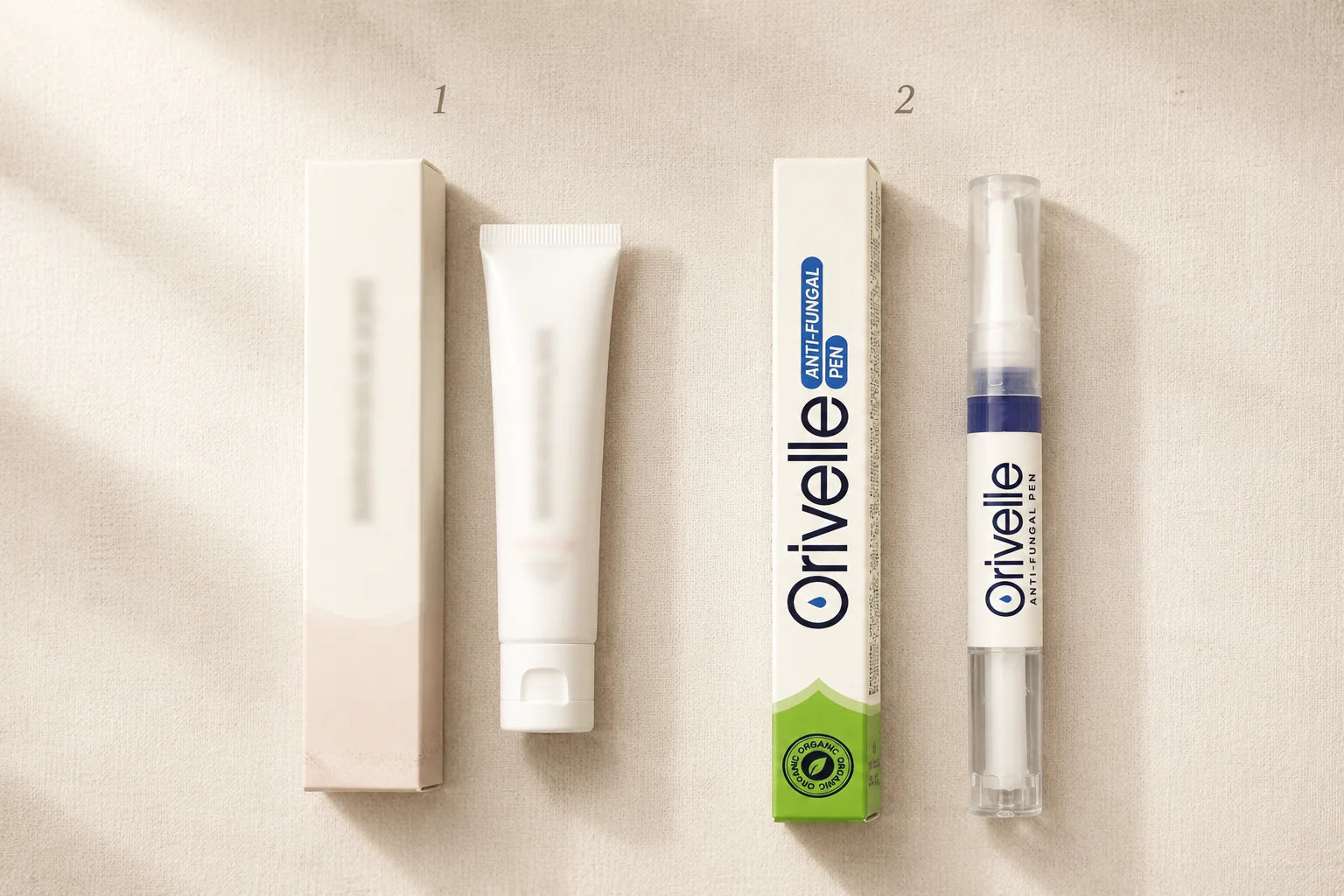
Orivelle is in a different category entirely. A 17-botanical OTC antifungal pen led by nano-formulated tea tree oil, designed to maintain antifungal pressure across the 9–12 month window it takes a thick fungal toenail to grow out from the matrix. 200,000+ verified customers, 4.9★ across 5,731+ reviews, 30-day money-back direct from the manufacturer.
If your toenail is just discolored or thickened cosmetically and you want it to look better quickly, Kerasal is doing the job it's designed for. If there's an actual fungal infection under the nail you want to kill — Kerasal's own label is honest about not being that product. Below is the 12-row breakdown.
The 12-row comparison
Orivelle wins 10 of the 12 rows that decide a fungal toenail outcome. Kerasal wins the two rows where it's honestly the better tool: cosmetic nail-appearance improvement (its actual job and label claim) and same-day pharmacy availability with 30-year brand recognition. If your goal is 'my nail looks rough and I want it to look better,' Kerasal wins those two. If your goal is 'kill the fungal infection,' the table makes the case for the other ten — and Kerasal's own label says that isn't what it does.
Kerasal
Cosmetic nail repair
Orivelle
OTC antifungal pen
All Kerasal data sourced from the public Kerasal product label, kerasal.com product description, and parent company Advantice Health's marketing materials. Orivelle data reflects the manufacturer's published user-study and product-page disclosures.
Read the front of any Kerasal Fungal Nail Renewal box, or visit kerasal.com today. The carefully-written product description says 'visibly improves the appearance of nails damaged by nail fungus.' That is the legal claim Kerasal makes. The product:
This isn't a copywriting choice — it's the FDA classification. Kerasal is registered as a cosmetic, and cosmetic products are explicitly prohibited from making treatment, cure, or prevention claims. Advantice Health, Kerasal's parent company, is in fact the same organization that brought the National Advertising Division (NAD) challenge against Lunavia in October 2025 — meaning they're acutely aware of what claim language is allowed in this category and what isn't. Kerasal's careful 'improves appearance' wording is exactly the kind of compliance posture you'd expect from a category-leading brand that's been on the shelf for decades.
The question most patients are actually asking when they put Kerasal in their cart isn't 'will this make my nail look cosmetically better?' — it's 'will this kill the fungus underneath?' And Kerasal's own label is unambiguous about the answer to that second question: the product makes no such claim.
Orivelle is in a different category. It's an OTC antifungal product designed around 17 plant compounds led by nano-formulated tea tree oil — a compound with documented antifungal activity against the same dermatophyte strains that cause onychomycosis (Buck et al. 1994 in J Family Practice; a 2024 paper in Frontiers in Microbiology).
Same drugstore aisle. Different category of product. Different job.
Kerasal's active ingredients are urea, propylene glycol, glycerin, and lactic acid. These are well-understood compounds in dermatology — but their job isn't to kill fungus. Their job is to soften and rehydrate keratin (the hard protein in nails). Urea is the most aggressive keratin softener on the market for OTC use; lactic acid is a mild exfoliant; propylene glycol and glycerin are humectants that pull moisture into the nail.
Together, they make a thickened, brittle, discolored fungal nail look smoother and feel softer. The trapped keratin debris that gets stuck under and around damaged nails clears more easily. The dehydrated nail surface becomes more flexible. The cosmetic appearance improves — sometimes substantially.
None of this kills fungus. The colony of dermatophyte fungi living deep under the nail plate isn't touched by keratin softeners. The fungus is still there, still actively growing, still the underlying cause of the nail damage.
Orivelle uses nano-formulated tea tree oil — emulsified at a particle size designed to penetrate the nail plate and reach the colony underneath. The pen-format precision applicator coats the nail, the cuticle, and the surrounding skin in a controlled antifungal layer. The 17 supporting botanicals work as a synergistic complex around the lead tea tree active.
The category mismatch: Keratin softening ≠ antifungal nail-plate penetration. Kerasal does exactly what its label says — softens the nail's cosmetic appearance. What it's not doing is reaching the colony living under the nail plate, because that's a different product category with a different mechanism.
Kerasal has been on drugstore shelves for over 20 years. Its reviews mostly describe what it's designed to do: 'my nails look smoother,' 'the discoloration on the surface lifted,' 'easier to trim,' 'the thickening reduced after a few weeks of use.' Those reviews are accurate to the product's actual job — keratin softening and cosmetic improvement.
What you'll also find buried in the longer-form Kerasal reviews on Amazon and Walmart is a recurring pattern: 'the surface looked better but the discoloration kept spreading underneath,' 'the fungus came back as soon as I stopped using it,' 'my doctor told me Kerasal isn't actually antifungal.' These reviews aren't accusing the product of being bad — they're describing the experience of users who bought it expecting an antifungal and got a cosmetic instead, then went looking for a product in the actual antifungal category.
Orivelle is in that actual antifungal category. The manufacturer reports more than 200,000 verified customers, a 4.9-star average across 5,731+ reviews, and an 84% reported success rate from their own user data. Many users report first visible improvements within 5–7 days per the product page.
Different product category. Different review depth. Different question being answered.

Real switchers
Quotes from former Kerasal customers who switched to a product in the actual antifungal category. The pattern: cosmetic improvement on the surface, fungal infection unchanged underneath.
Used Kerasal nightly for six months. The thickening got better and the nail looked smoother — the cosmetic improvement was real. But the discoloration kept creeping toward the cuticle. My podiatrist finally explained Kerasal is technically a cosmetic, not an antifungal. Switched to the 17-botanical pen and the new nail is finally growing in clean.
Karen H.
Previously used: Kerasal Fungal Nail Renewal (6 months)
Bought Kerasal because of the '#1 Doctor Recommended' tagline. Used it for three months, $20 each tube. Then I actually read the label closely and noticed it just says 'improves appearance' — never claims to kill fungus. Returned the rest, ordered the Orivelle 6-pack at $9.99 per pen. Three months in and the cuticle is finally a normal color.
Robert L.
Previously used: Kerasal (3 months)
Kerasal made my toenail look so much smoother — that part was true. But the underlying yellow color was getting worse, not better. Took me two more cycles before I figured out I needed an actual antifungal. The pen has been completely different — the discoloration is finally lifting from the matrix.
Patricia K.
Previously used: Kerasal (multiple cycles)
Individual results vary. Quotes adapted from publicly available reviews of comparable formulas; names abbreviated for privacy.
You asked
The objections that survive the table.
No. Kerasal is FDA-classified as a cosmetic. Its own product description on kerasal.com says it 'visibly improves the appearance of nails damaged by nail fungus' — it does not say it treats, kills, or prevents fungal infection. The active ingredients (urea, propylene glycol, glycerin, lactic acid) are keratin softeners and moisturizers, not antifungal compounds. Kerasal's label is honest about being a cosmetic appearance product.
Yes — for what it's actually designed to do. Kerasal does soften and rehydrate the keratin of a thickened, discolored fungal nail, and the cosmetic appearance often improves substantially. If your goal is the appearance of the nail, Kerasal works. If your goal is to clear an underlying fungal infection, Kerasal isn't designed for that and the label says so.
Urea and lactic acid soften the hard keratin layer that builds up on a thickened, infected nail. This makes the surface smoother, lets trapped debris clear, and lifts the discoloration that's stuck in the keratin. Your nail looks better cosmetically — but the colony of dermatophyte fungi living under the nail plate hasn't been touched, because that requires an antifungal compound.
That's a reasonable two-product approach for some patients with very thick, debris-laden nails — soften cosmetically with Kerasal, treat antifungally with Orivelle. But for most cases, the antifungal pen alone is enough — its precision applicator handles the active job, and the new clean nail grows in from the matrix as the old infected one grows out.
Yes — there's no interaction or lock-in. Stop Kerasal whenever you want, or finish the tube for cosmetic reasons, and start Orivelle in parallel. Most podiatrists would say the antifungal pen is the priority if there's an active infection — Kerasal alone won't address the underlying cause.
Orivelle ships with a 30-day money-back guarantee direct from the manufacturer. Free shipping on all multi-pen packs. The guarantee covers the cost of the product if you're not seeing visible improvement in the first 30 days.
The verdict
The verdict on Kerasal depends entirely on which job you're trying to do:
If your goal is cosmetic appearance only
Kerasal is doing the job it was designed for. Its label is honest about being a cosmetic, and at $17–$24 it's a reasonable purchase for keratin softening.
If your goal is killing the fungus
Kerasal isn't the tool — Kerasal's own label says it isn't an antifungal. A product in the actual antifungal category is what's designed for that job.
If you've been using Kerasal for months
And the surface looks better but the discoloration kept spreading underneath — switch to a multi-botanical antifungal pen designed for nail-plate penetration.
If your goal is antifungal — there's a fungal infection in the nail that you want to kill and keep dead for the 9 months it takes the new nail to grow out — Kerasal isn't the tool, because Kerasal's own label says it isn't an antifungal. A product in the antifungal category — a multi-compound formula designed around penetrating the nail plate and maintaining antifungal pressure across the full grow-out window — is what gives you a realistic shot at clearing the infection.
Current pricing on Orivelle's official site:
1 pen
$19.99
3 pens (2 + 1 free)
$13.99 each · $41.97 total
6 pens (3 + 3 free)
$9.99 each · $59.94 total
For most patients I see who've already used Kerasal hoping it would clear a fungal infection, I'd suggest the 6-pack. Per-pen price drops to $9.99 — actually less than half what a Kerasal tube costs at the drugstore — and you have enough pens to run consistently for the 9 to 12 months a thick fungal toenail needs to fully grow out from the matrix.
30-day money-back guarantee · Free shipping · 200,000+ verified customers · 4.9-star rating across 5,731+ reviews · 84% reported success rate