A podiatrist walks through what a thick toenail actually means — and why most antifungal treatments work for two weeks, then stop, or come back stronger when you stop using them.

The short answer
If you're 50 or older and your shoes have stopped fitting comfortably at the front — or if a nail you've had for years is now thick enough that you've started filing it down just to slide your foot in — there are five things it could be. For most adults over 50, the answer is fungal infection (onychomycosis). But three of the other four don't need treatment at all, and one needs a dermatologist, not a pen. So the right next step depends on which one you have.
Most people Google this question the same way: half-hoping the answer is "just age, ignore it" — half-worried that ignoring it is exactly how a thick toenail ends up looking like a horn and hurting in every shoe you own. Both reads are correct. Three of the five causes below really are "ignore it." Two of them aren't. Mistaking which group you're in can cost you the next ten summers of open-toed shoes, and the test takes about four minutes to run.
What this guide does differently: section 5 is the one most readers got wrong before — the cause almost everyone has, and the specific reason most over-the-counter products make it come back worse than it started. If you've been treating yours and watching it return, that's where you'll want to read twice.
Below, in the order I'd walk through them with you in the office: easiest causes to rule out first, the most common one last.
The first cause I rule out is acute trauma — and it's almost always the big toe.
A stubbed toe years ago. A piece of furniture you dropped on it once. A season of running where the shoes were a half-size too small. The matrix at the base of the nail — the cell factory that produces the plate — gets bruised, and once it's been damaged, it sometimes never makes a flat, even nail again. The new nail grows in thicker, ridged, raised at the surface — and stays that way.
Tell-tale signs: the thickening is on one nail (almost always the big toe), there's no crumbling at the tip, no spread of color toward the cuticle, and you can usually trace it back to a specific event you'd half-forgotten about.
If that fits, you don't need a treatment. The thickening is structural. A podiatrist can file the surface flat for cosmetic reasons, but no cream or pen will reverse matrix damage.
The second cause is slower than trauma, but probably more common: chronic pressure.
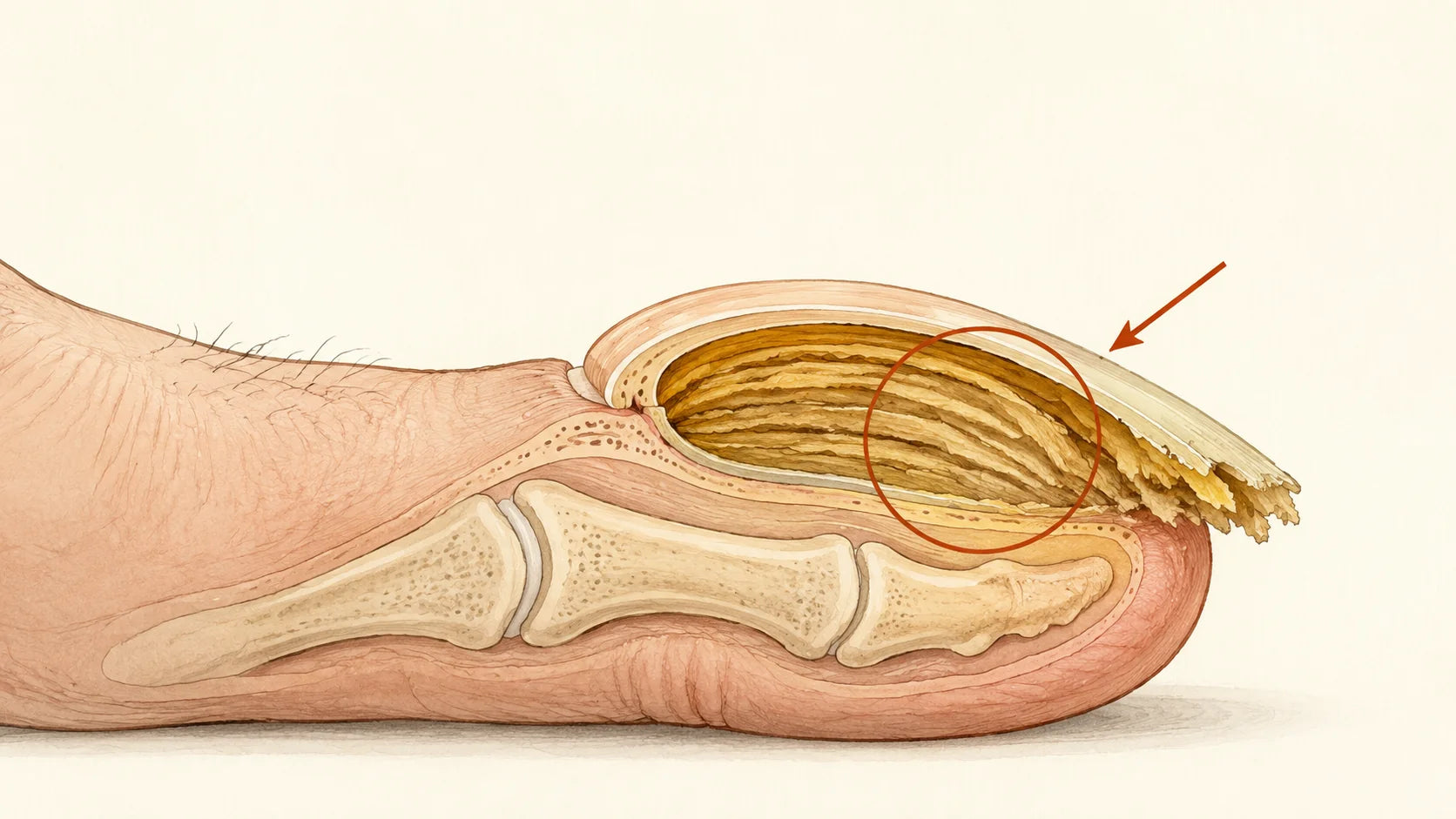
When a shoe is too tight in the toe box, when running impact compresses the front of the foot a million times over a decade, or when bunions or hammertoes shift the weight of every step onto one toe — the body responds the way it always responds to friction. It builds callus. But this callus forms under the nail, in a layer of thick keratin that lifts the plate up and outward. The medical name is subungual hyperkeratosis.
This is what people are describing when they search for thick skin under toenail or thick white stuff under toenail. It's not a separate disease. It's the foot's repair response to long-term pressure.
Tell-tale signs: the thickening builds gradually over many years (not months), often affects more than one toe, the underside looks pale or chalky-white when you trim it, and the whole thing softens noticeably after a long foot bath. Look at the shoes you've worn the last decade — narrow toe boxes, pointed dress shoes, tight running shoes are usually the culprit.
A quick win for some readers, and worth ruling out before spending money on antifungal products that aren't going to address pressure damage.
A small but important subset of thick toenails come from skin conditions — and this is where the "I'm pretty sure it's not fungus" instinct is usually correct.
The big four to know:
Psoriasis. Pitting (small dents on the surface), thickening, sometimes a yellow-brown patch that looks identical to fungus. Often shows up on the fingernails too. Usually accompanied by red, scaly patches of skin elsewhere on the body.
Lichen planus. Ridges, splitting, sometimes thinning and thickening on different nails of the same hand or foot.
Severe eczema around the nail folds. Chronic skin inflammation can cause the matrix to produce uneven, thickened nails.
Yellow Nail Syndrome. Rare, but produces multiple yellow, thick, slow-growing nails on fingers and toes simultaneously. (If your nails are also turning distinctly yellow, see our companion piece on what yellow toenails actually mean.)
Tell-tale signs: multiple nails on both fingers and toes are affected, you have a personal or family history of psoriasis or eczema, or you have skin issues elsewhere — scalp, elbows, knees, behind the ears.
If that fits, see a dermatologist before assuming it's fungus. Antifungal pens won't help a psoriatic nail. A topical steroid prescribed by a derm will.
After about age 50, toenails change. Blood flow to the feet decreases. Growth slows. The matrix produces a slightly thicker, slightly more brittle plate. The medical term is onychauxis — age-related nail thickening, no infection, no underlying disease. For most people, it's purely cosmetic. The nail looks thicker, slightly more yellow-tan than translucent pink, grows more slowly. That's it.
But here's the trap I see weekly. Most "age-related thickening" is actually onychauxis plus a slow fungal infection that's been progressing quietly because the patient assumed it was just aging.
One of my patients — call her Diane, 67 — came in last year because her shoes had stopped fitting. The big toenails on both feet had thickened so much they were pressing into the toe box of every closed shoe she owned. "They look more like horns than nails," she said. "I've been filing them just to fit my feet into my shoes." She'd worn the same orthopedic sandals for the last six years. "I just thought my feet were getting old." A nail clipping under the microscope confirmed onychomycosis on top of the natural age-related thickening. By the time she came in, the fungus had been spreading for an estimated decade.
Diane's case is also a soft warning for anyone reading this with diabetes: thick fungal nails press into shoes, create pressure points the patient can't feel, and that's how diabetic foot ulcers start. If you're diabetic and your toenails are thickening, this is a podiatrist visit, not a self-diagnosis.
Signs that age alone doesn't explain it: the nail is crumbling at the tip when you trim it, color is spreading from the tip toward the cuticle (not just uniformly tan), there's a faint smell, the thickening is increasing fast enough to notice quarter-to-quarter, or the nail has started to hurt when pressed.

If you've ruled out the four causes above, onychomycosis — toenail fungus — is what's left. About half of all thick, discolored toenails have a fungal component. For adults over 40, it's the single most common cause.
You probably already suspected this. Most readers do.
The harder question — the one almost nobody answers correctly — is why the standard creams, pens, and drugstore products keep failing. I had a patient last year tell me she'd used 9 bottles over a decade of one well-known prescription topical, watched the nail look better for a few weeks each time, and ended every cycle exactly where she started.
For 30 years I told patients the same thing your doctor probably told you: that some cases were just "stubborn." I was wrong about why.
The honest answer comes from a holistic skin and nail specialist named Dr. Alan Meyers — the developer behind a pen-format treatment called Orivelle, currently used by more than 200,000 verified customers (more than the population of Salt Lake City).
Here's what Dr. Meyers wrote about why standard treatments fail:
— Dr. Alan Meyers, formulator (Orivelle product page)Most over-the-counter treatments only scratch the surface — and in many cases they dry out and weaken the skin barrier, making it easier for fungus to come back.
That single sentence explains a paradox patients have been describing for years: the cream "works" for two weeks, the nail looks better, then it stops — or worse, the fungus comes back stronger after they stop using it.
The reason is the skin barrier itself. Harsh synthetic antifungals strip the skin's natural acid mantle (pH 4.5–5.5). Once that mantle is gone, the skin actually becomes more hospitable to fungal recolonization. The treatment creates the conditions for the fungus to return.
That's the one reason most treatments don't just fail — they make the next infection harder to clear than the one before it. Every cycle of "try a cream, see partial improvement, watch the fungus come back" leaves the skin more vulnerable than the cycle before. After three or four rounds of this, patients walk into my office convinced their case is "stubborn." It isn't. The treatments were stripping the only defense the skin had.
Orivelle's 17-ingredient natural formula was designed around the opposite approach — plant-based compounds (tea tree oil, vitamin C, peppermint, jojoba, evening primrose, rosehip, and 11 more) that fight the fungus while supporting the skin barrier instead of stripping it. The pen-format applicator coats every part of the nail and surrounding skin without the mess of drops or creams.
The reported numbers from Orivelle's own user study: 84% noted noticeable improvement in nail clarity and strength after consistent use. Many report first visible improvements within 5–7 days. The thickness takes longer to come down — nails grow about 1mm per month, so a fully restored plate from the matrix takes 9 to 12 months — but the color, smell, and crumbling at the tip start changing fast.

What to do next
If you suspect fungus rather than trauma, pressure, skin condition, or age, here's what consistent use looks like.
Apply twice daily
Morning and night, on clean dry feet. Twist the pen, brush a thin layer onto the affected nail and surrounding skin, let it absorb. No rinse.
First visible improvements
Typically show within 5–7 days for most users. Color, smell, and the crumbling at the tip change first; thickness comes later as new healthy nail grows in from the matrix.
Skip nail polish or acrylics
During treatment so the formula can fully absorb.
Address the source
Damp shoes, shared pedicure tools, gym showers, or an athlete's-foot infection that migrated to the nail.
If you've tried three or more antifungal products without lasting results, and you've ruled out the four non-fungus causes above, Orivelle is the thick-toenail remedy I'd consider next — a 17-ingredient natural formula designed to fight fungus and support the skin barrier instead of stripping it.
Current pricing on Orivelle's official site:
1 pen
$19.99
3 pens (2 + 1 free)
$13.99 each · $41.97 total
6 pens (3 + 3 free)
$9.99 each · $59.94 total
For most patients I see who've already tried multiple OTC products, I'd suggest the 6-pack. The per-pen price drops to $9.99 and you have enough to use consistently for the 9 to 12 months it takes for a thick toenail to fully grow out from the matrix. (For comparison, a 48-week course of one common prescription topical runs roughly $1,700 at retail, with about a 17% reported clearance rate.)
30-day money-back guarantee · Free shipping · 200,000+ verified customers · 4.9-star rating across 5,731+ reviews · 84% reported success rate